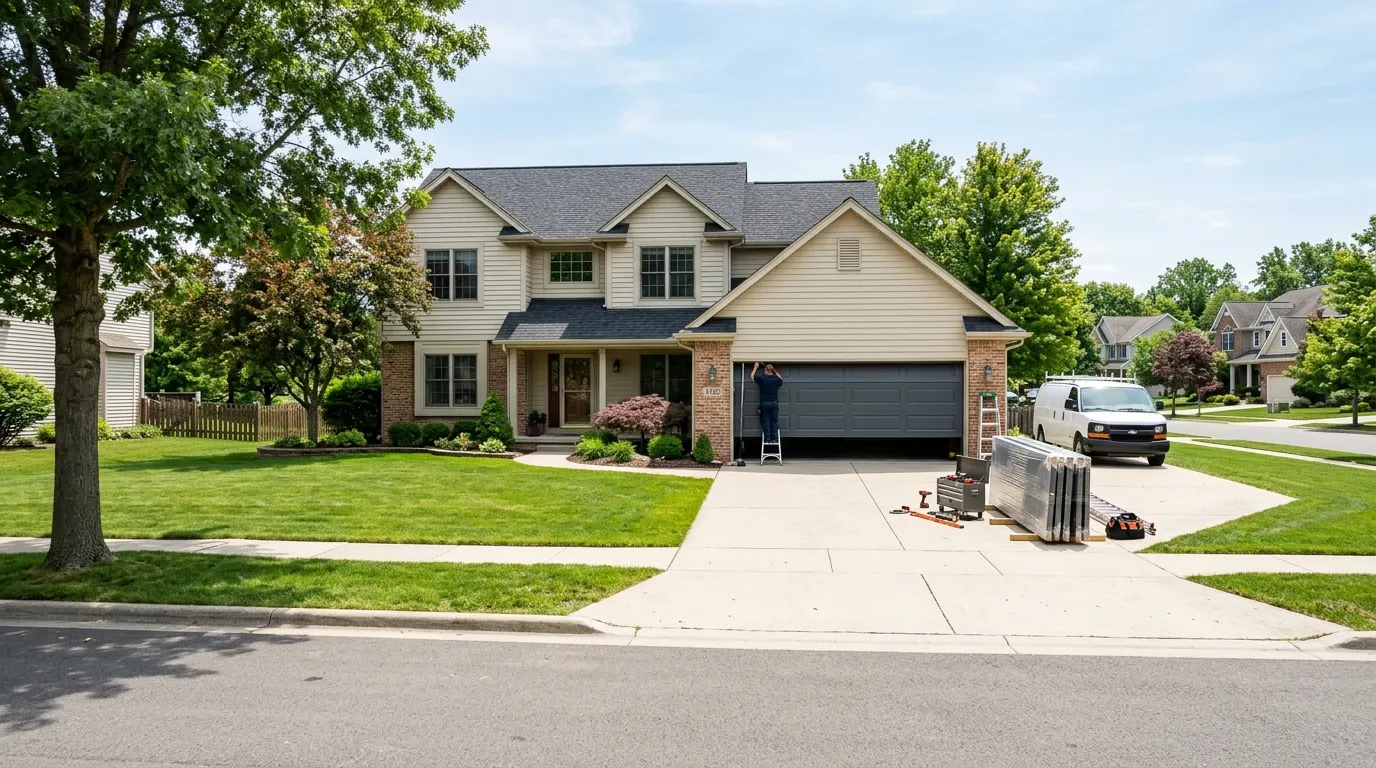
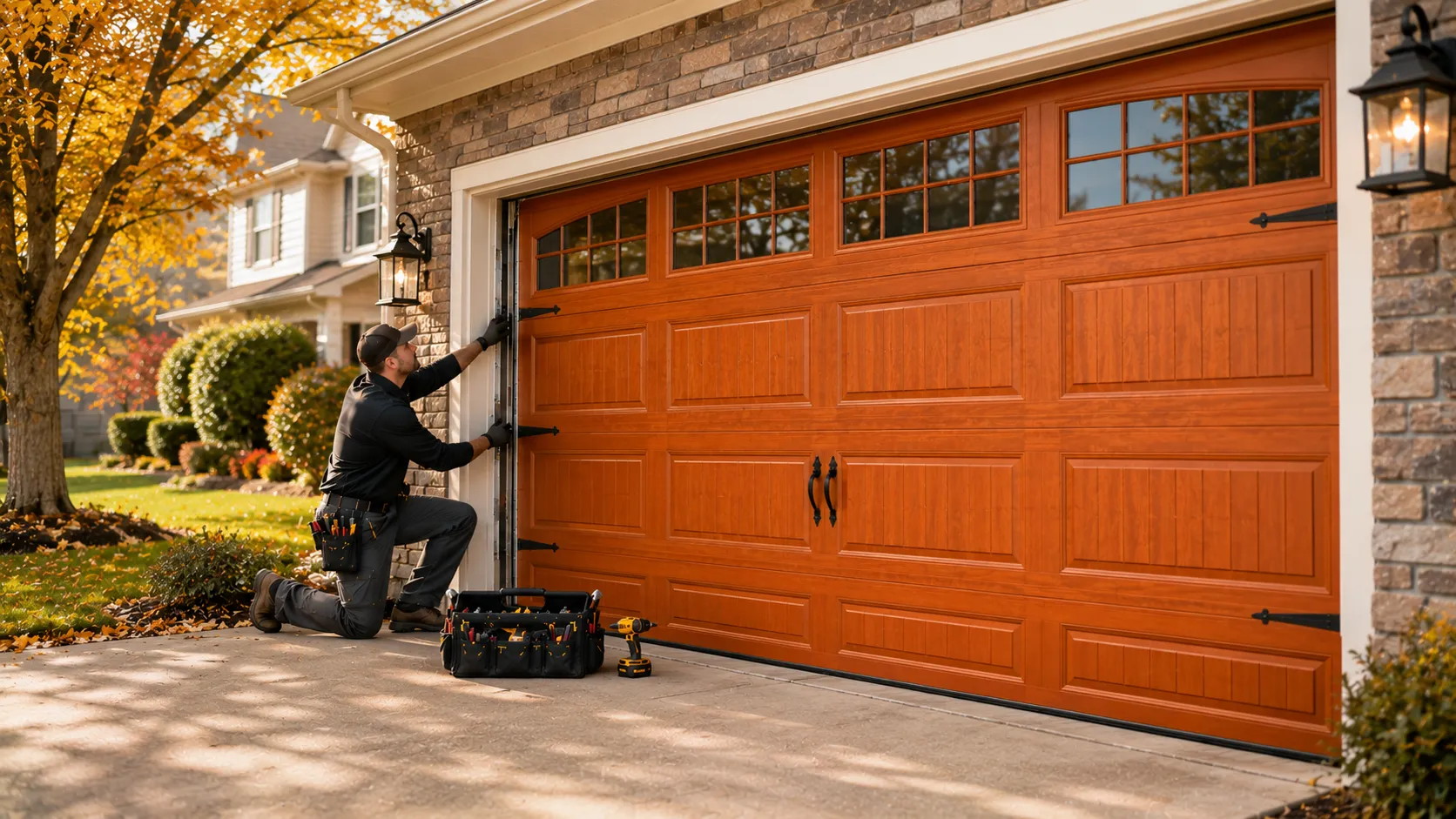
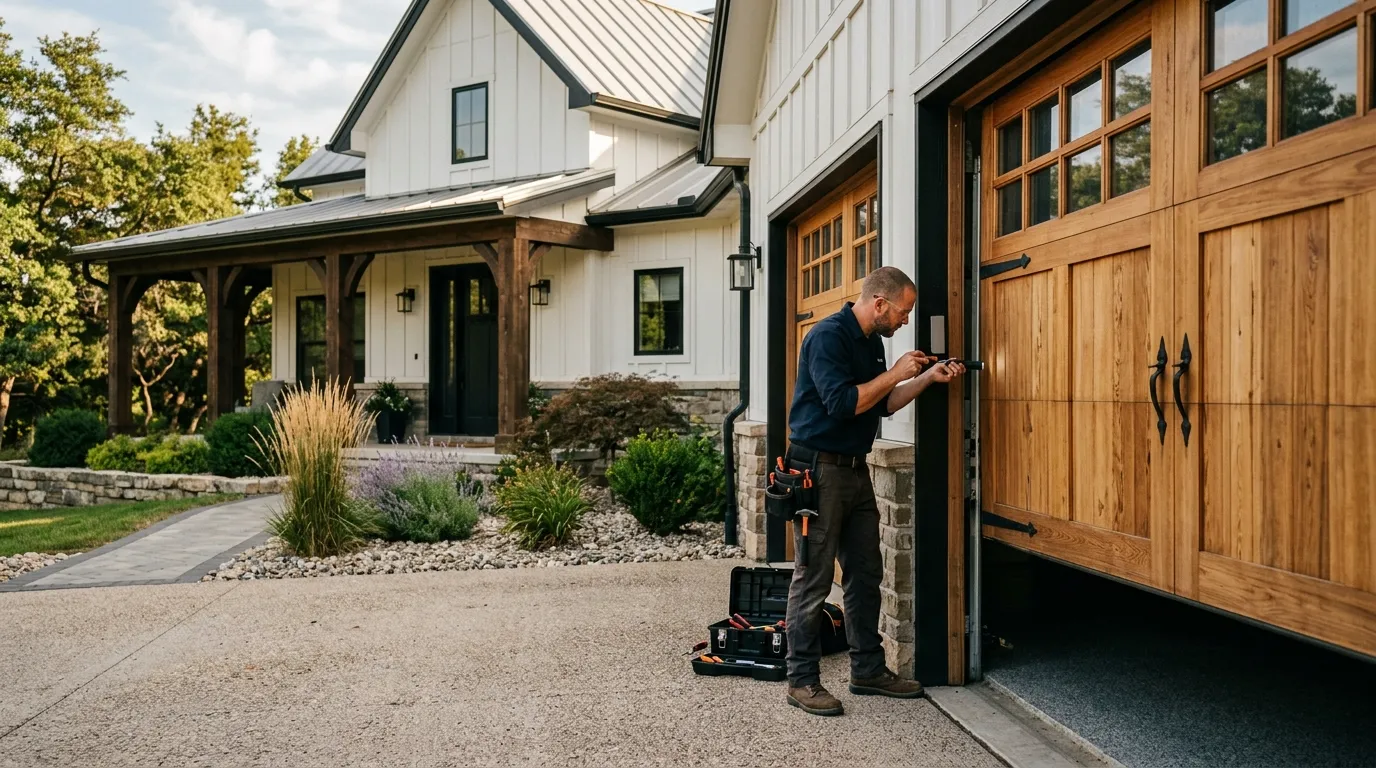
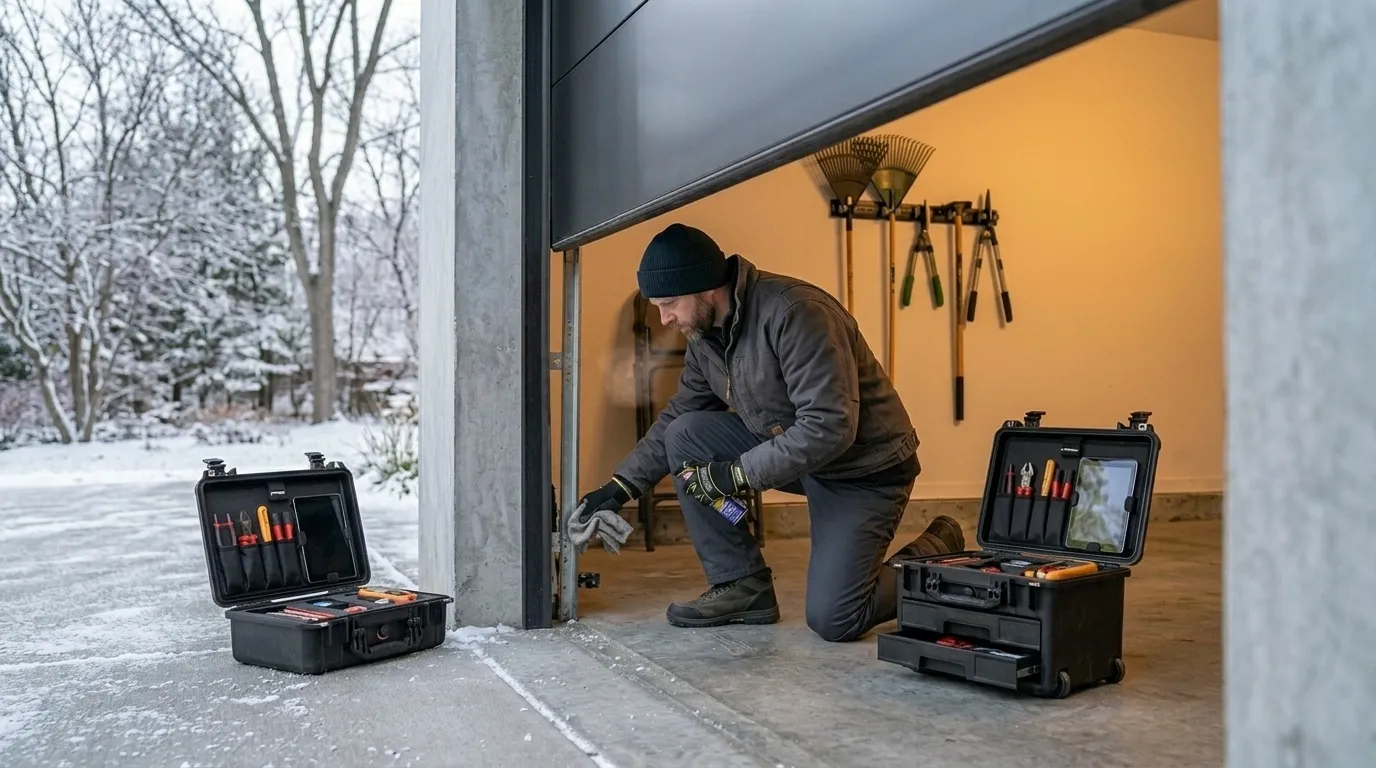
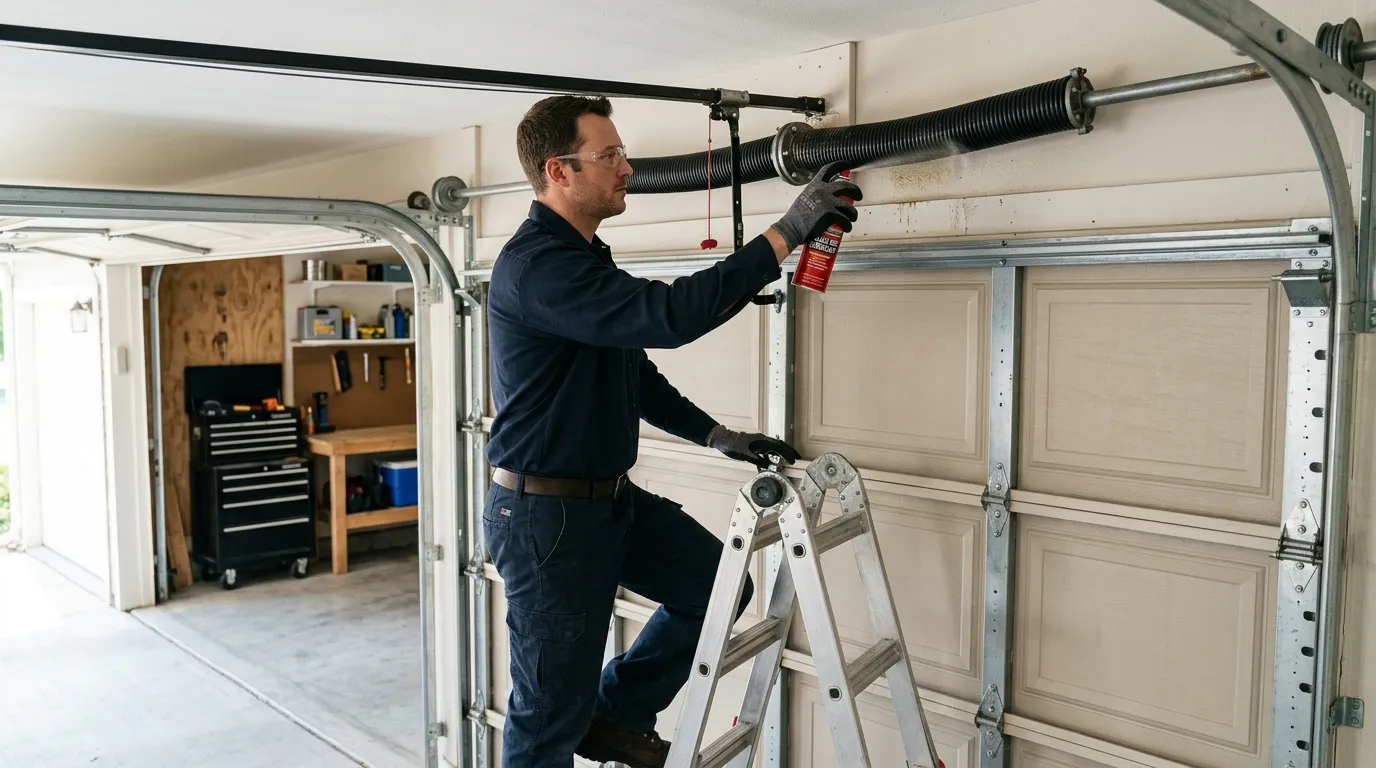
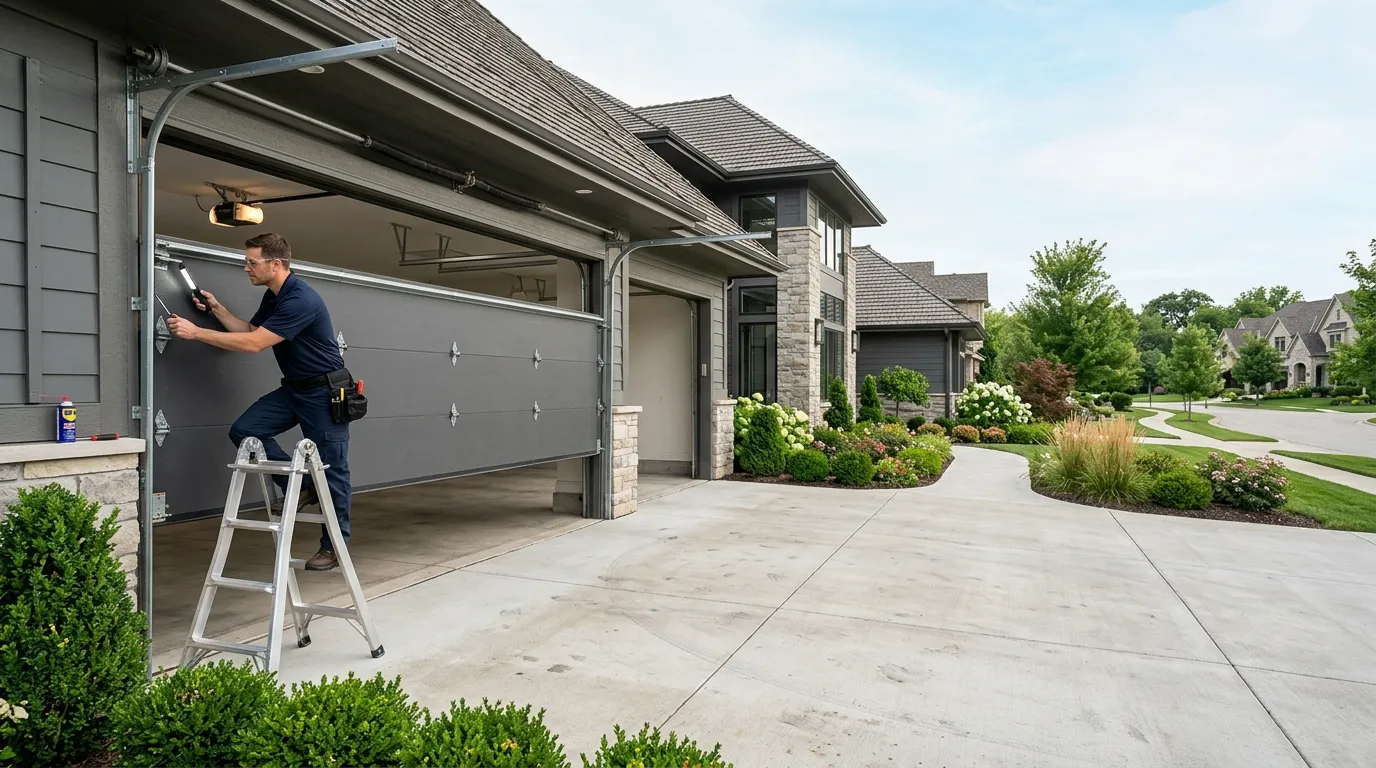
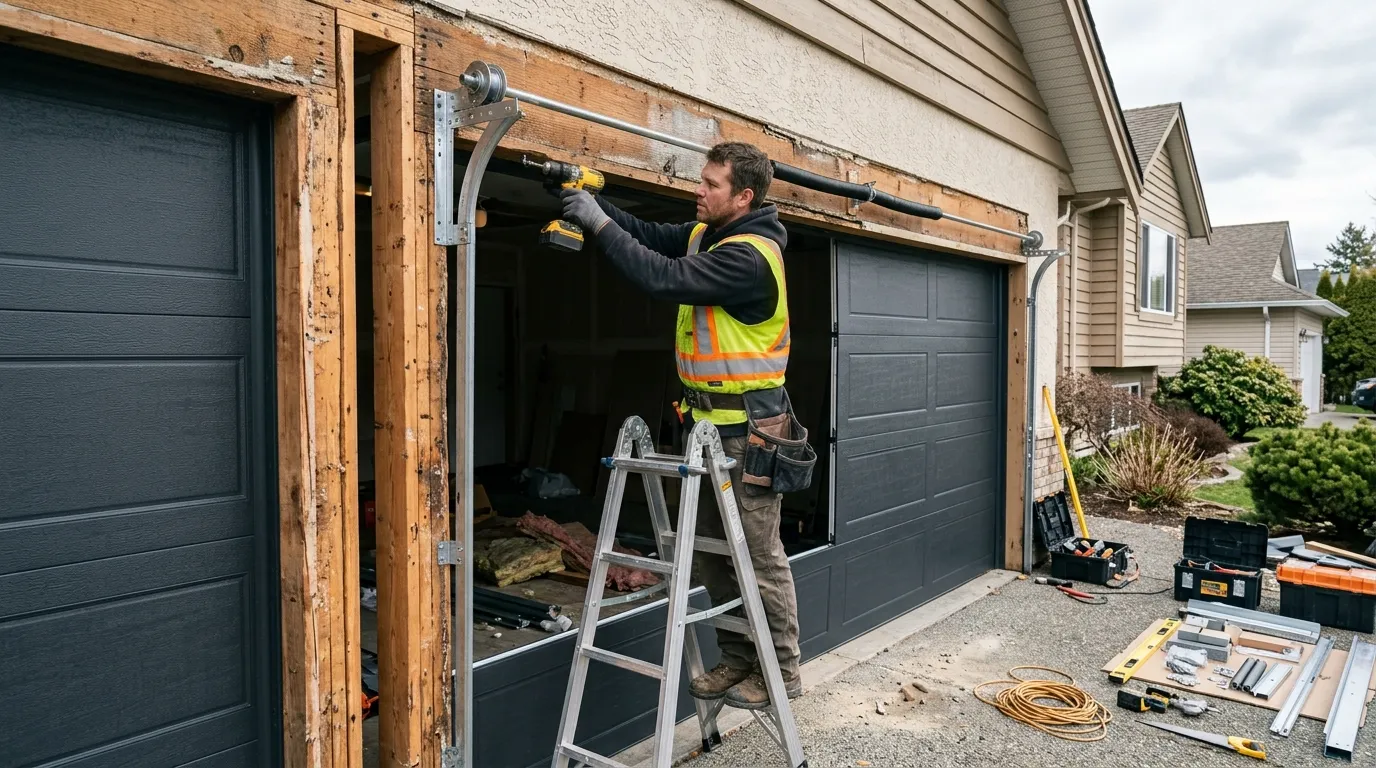
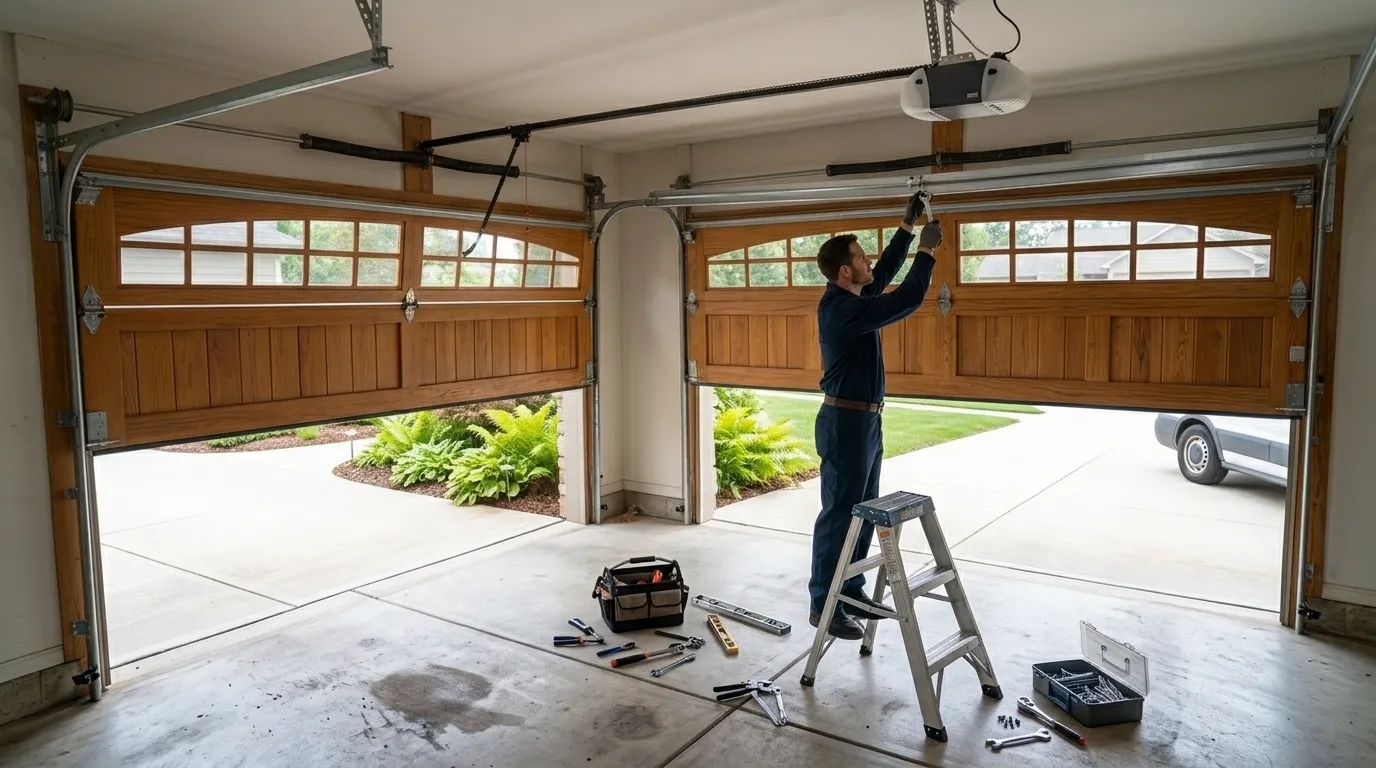
Before you call anyone, you can rule out a few things on your own. Pull the release handle with the door down and lift the door by hand. If it's balanced, it should stay put around waist height and move with light effort. If it slams down or you can barely lift it, that's a spring problem, not an opener problem, and it's not a DIY fix. Look at the tracks for dents or gaps where the rollers sit - a lot of houses in this area still have the original steel tracks from when the place was built, and 60-plus years of expansion and contraction leaves them slightly out of true even if nothing looks obviously broken. Listen for the sound: a clean hum is fine, a grinding or popping noise usually means a roller or bearing is on its way out. What you shouldn't do is touch the torsion spring itself. Those things carry enough tension to break a bone, and given how much of the stock here is original 1940s-1950s hardware, a spring that's due for failure won't give you much warning. If your check turns up a bent track, a spring that won't hold its position, or cables that look frayed, that's the point where you stop and call it in.
The Problem
Most of the doors we get called out for sit on houses that went up between 1943 and 1959, which is the bulk of what's on the ground here. That era means original torsion-spring setups, single-layer steel or wood panels without any real insulation core, and openers that have been swapped once or twice but bolted onto the same 70-year-old header. The spring is almost always the first thing to go, because it was sized and wound for a door that's since been repainted, re-hinged, or had a heavier opener added on top of it. Panels from that period also tend to be thinner than what's sold today, so a small dent from a bumped car turns into a warped section that throws the whole door out of alignment. We also see a fair number of openers that are original to a remodel from decades back - chain-drive units with worn sprockets that finally start skipping teeth. None of this is exotic. It's just what happens when a door built for a 1950s garage keeps running daily in 2024, and the parts wear on a schedule that has nothing to do with brand or price point - it's about age.
Doing Nothing For Now
A door that's slightly out of balance or a little noisy will usually keep working for a while - that's the honest part. But on hardware this old, the failure mode is rarely gradual. A frayed cable on a pre-1960 setup tends to snap rather than slip, and when it does, the door drops fast with whatever weight the spring was no longer carrying evenly. Waiting on a bent track means the rollers keep grinding a wider path, and what starts as a $150 roller job turns into a track replacement. We won't tell you every noise needs an emergency call - a lot of the squeaks are just a dry hinge. But if the door is already hard to lift by hand, that's tension leaving the spring, and it doesn't come back. One thing we're upfront about: if a door is original to a 1940s build and the track, spring, and panel are all failing at once, replacement usually costs less over time than three separate repair visits. We'll tell you that instead of running the meter.
What Local Conditions Do
This area sits in a moderate heat band, not the kind of desert swing that cracks seals or the freeze-thaw cycle that splits concrete slabs up north. So the wear we see on doors around Burbank isn't storm damage or ice - it's just time and use. Across the wider service area, which covers 45 named communities from La Crescenta-Montrose down through places like Alhambra and Culver City, the housing stock is mostly pre-1960, which means the same original hardware problem shows up house after house regardless of which side of town you're on. With 145,743 owner-occupied houses in that footprint and a median household income of $86,956, most of the calls we get are repair calls on aging equipment, not full replacements on new builds. Burbank itself sits within 4 miles of North Hollywood, Sun Valley, and Valley Village, and within 6 miles of La Crescenta-Montrose - close enough that the same 1940s-1960s tract housing pattern runs right through all of them. The moderate climate means your door's problems are mechanical, not weather-driven.
How it works
From “it’s stuck” to “it’s fixed”
01
Tell us what’s wrong
Describe the symptom - won’t open, loud bang, opener runs but the door won’t move.
02
On-site diagnosis
A technician tests the door under power and by hand and finds what actually failed.
03
Clear, up-front plan
You get the fix that’s needed and what drives the cost - before any work starts.
04
Repaired & tested
The repair is done, the door is set true and tested, and the work area left clean.
Next step
Serving Burbank, CA - tell us what your door’s doing and we’ll take it from there.
Straight answers about garage door repair in Burbank. Still unsure? Ask us directly.
Why does my garage door feel heavy to lift by hand?
That's almost always a torsion spring losing tension, which is common on the original hardware still found on a lot of houses built here between 1943 and 1959. It's not something to force open repeatedly - the spring is doing less work each time, and the cables end up carrying weight they weren't meant to.
Is it the heat causing my opener to act up?
Unlikely on its own. This area sits in a moderate heat band, not the extreme swings that stress seals or electronics elsewhere. If your opener is acting up, it's more likely age or a worn sprocket than the weather.
How old is too old for a garage door opener?
We don't have a hard cutoff number for you, but if the opener predates a couple of remodels on a house built in the 1940s or 50s, and it's chain-drive with a skipping sprocket, repair parts get harder to source. At that point replacement often makes more sense than another patch.